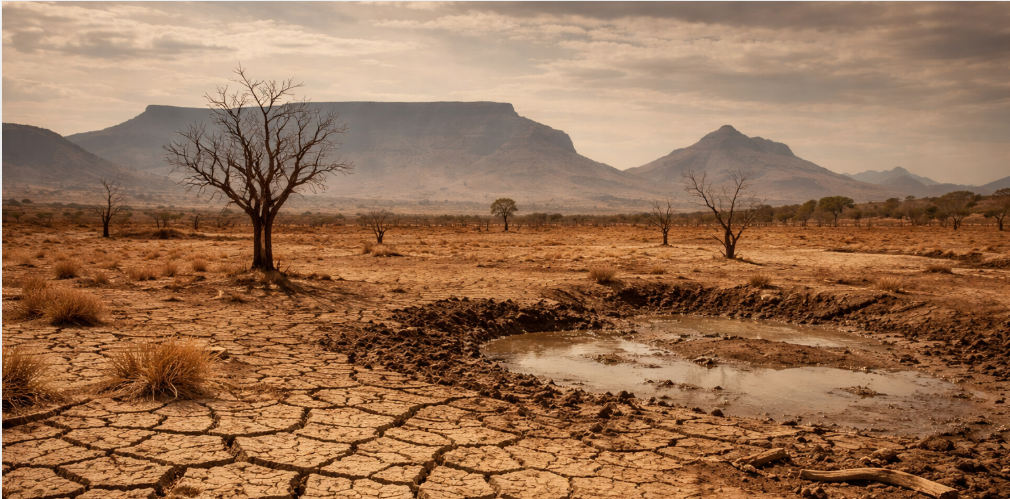
Southern Africa is enduring its worst drought in over a century. Sixty-one million people are affected. Six nations have declared disaster. But beneath the headlines, a silent, manmade crisis is draining the continent's water before it ever reaches a tap, and African Sun Holdings is doing something about it.
The 2024–2026 Southern African drought, driven by El Niño and compounded by climate change, has left 61 million people in crisis. But invasive alien plant species are silently consuming 3.3 billion cubic metres of South Africa's water every year. African Sun Holdings is investing in large-scale invasive species removal to restore water tables, create employment, and build long-term ecological resilience. Every claim in this issue is sourced.
A Century-Defining Drought
February 2024 was the driest February in the 40-year satellite data record for an area spanning Zambia, Zimbabwe, southeastern Angola, and northern Botswana. From late January through mid-March, parts of Southern Africa received half or less of their typical rainfall. The World Food Programme has described it as the worst mid-season dry spell in over 100 years.
Six countries, Botswana, Lesotho, Malawi, Namibia, Zambia, and Zimbabwe, declared national drought disasters. In Zambia, maize production collapsed by 54%, with crops withering on one million hectares, nearly half the country's maize-growing area. Zimbabwe's cereal harvest fell 50% below the five-year average. Malawi's dropped 43%.
By September 2024, the UN Office for the Coordination of Humanitarian Affairs (OCHA) reported that 61 million people were affected across the region. Over 30 million needed food assistance during the October 2024 to March 2025 lean season. Twenty-one million children were malnourished.
Sources: NASA Earth Observatory, "Severe Drought in Southern Africa," 2024; WFP, "Southern Africa Drought," 2024; OCHA, "Southern Africa El Niño Regional Humanitarian Overview," September 2024; WFP, "Urgent Call to Action to Address Historic El Niño Drought in Southern Africa," 2024.
I met farmers who usually grow enough to feed their families and communities. This year they harvested nothing.
— Cindy McCain, Executive Director, World Food Programme · Visit to Zambia, 2024The Human Cost: Lives on the Edge
Seventy percent of Southern Africa's population relies on agriculture for survival. When the rains fail, it is not a market inconvenience; it is a humanitarian catastrophe. The Southern African Development Community (SADC) launched a humanitarian appeal for US$5.5 billion. The World Food Programme alone needed US$147 million to provide food and cash assistance to 7.2 million people through March 2025.
The crisis is not evenly distributed. In Zimbabwe, 7.6 million people needed assistance. In Zambia, 6.6 million. In Malawi, 6.1 million. In Madagascar, 2.8 million. In Mozambique, 1.8 million. President Emmerson Mnangagwa of Zimbabwe stated that "more than 80% of our country received below normal rainfall" as he declared a state of disaster in April 2024.
OCHA reported that needs were assessed at 50% higher than the 2016/2017 drought season, with nearly three times more people affected compared to the last severe El Niño event in 2016.
Sources: WFP, "Southern Africa Drought Emergency," 2024; SADC and Humanitarian Partners, "Call for Scaled Assistance," 2024; PBS News, "Zimbabwe Declares State of Disaster," April 2024; OCHA, Regional Humanitarian Overview, September 2024.
People in Southern Africa are on the frontlines of the climate crisis.
— Reena Ghelani, UN Assistant Secretary-General & Climate Crisis Coordinator · SADC, 2024What Caused This?
The primary driver of the 2024 drought was El Niño. A peer-reviewed study by the World Weather Attribution initiative (April 2024) concluded that El Niño, not human-caused climate change alone, was the main driver. Droughts of this type are twice as likely during El Niño years. The study, led by Joyce Kimutai of Imperial College London, found that these events are expected roughly once every decade under current climate conditions.
Shifted rainfall patterns during the critical December–February growing season. Droughts of this magnitude are twice as likely during El Niño years. (World Weather Attribution, April 2024)
Higher temperatures increase evapotranspiration, intensifying the impact of any rainfall deficit. Climate change also increases the frequency and intensity of El Niño events. (World Weather Attribution, April 2024)
But there is a third factor, one that is rarely discussed in the headlines. Invasive alien plant species are consuming billions of cubic metres of Southern Africa's water every year. This is not a natural disaster. It is a manmade crisis layered on top of a natural one, and it is the factor most within our power to address.
Sources: World Weather Attribution, "El Niño Key Driver of Drought in Highly Vulnerable Southern African Countries," April 2024; Joyce Kimutai et al., Imperial College London.
Attribution studies have shown that many extreme weather events have been driven by a combination of both climate change and El Niño.
— Joyce Kimutai, Researcher, Imperial College London · World Weather Attribution, April 2024The Invisible Thief: Invasive Species and the Water Table
While the drought dominates headlines, a quieter crisis has been draining Southern Africa's water resources for decades. Research led by the late Professor David Le Maitre of the Council for Scientific and Industrial Research (CSIR) found that invasive alien plants reduce South Africa's mean annual runoff by an estimated 3,300 million cubic metres per year, approximately 6.7% of the national total. An earlier national assessment estimated the loss at 1,444 million cubic metres per year; enough to supply 3.38 million households with water for a year, or irrigate 120,000 hectares of cropland.
The worst offenders are well documented. Black wattle (Acacia mearnsii and related species) accounts for 34% of total water reductions. In high-rainfall areas, riparian black wattle consumes up to 46% more water than mean annual rainfall. Pine species account for 19.3% of water reductions; clearing riparian pines in one Western Cape catchment led to a 48% increase in surface runoff. Eucalyptus species account for 15.8%, with annual evaporation of 1,200–1,400 mm per year compared to 600–900 mm for the native grasslands and woodlands they replaced.
Prosopis trees drain groundwater directly, with each invaded hectare losing 345 cubic metres of groundwater annually. Pine plantations can reduce streamflow by 82% within 20 years of establishment and dry out streams entirely within 6–12 years.
To put this in perspective: During Cape Town's 2018 "Day Zero" water crisis, researchers estimated that clearing invasive plants from the city's catchment areas could have delayed the crisis by 60 days. (Greater Cape Town Water Fund / The Nature Conservancy)
Sources: Le Maitre et al., "Estimates of the Impacts of Invasive Alien Plants on Water Flows in South Africa," Water SA, 2016; CSIR; Dzikiti et al., Prosopis groundwater research; Scott et al., long-term pine/eucalyptus streamflow studies; Greater Cape Town Water Fund / The Nature Conservancy.
Invasive alien plants are the single biggest long-term threat to our water security.
— Dr Guy Preston, Founder, Working for Water Programme · Department of Forestry, Fisheries and the EnvironmentA Proven Solution: Clearing Invasives, Restoring Water
The science on invasive species removal and water recovery is unambiguous. South Africa's Working for Water (WfW) programme, launched in 1995, has cleared over 3 million hectares of invasive plants across all nine provinces. The results are measurable: after clearing, streamflow increases by 8,000 to 34,000 litres per hectare per day, depending on the season.
In the Western Cape alone, 46,000 hectares cleared since 2023 are recovering over 15 billion litres of water per year. In the Eastern Cape, clearing just 269 hectares of black wattle and Port Jackson willow freed enough water for 16,000 households for a year. Clearing just 7% of riparian invasions in one study area yielded an estimated 34.4 million cubic metres, equivalent to 42% of the yield of the Berg River Dam scheme.
Research suggests that nationwide invasive species clearing could yield 997 million cubic metres of additional water by 2050, a quarter of all planned built infrastructure gains, and at a fraction of the cost.
Water recovery: 8,000–34,000 litres per hectare per day after clearing (WfW/DFFE)
Employment: ~50,000 jobs per year; 300,000+ people trained since 1995 (WfW/WRI)
Cost efficiency: More cost-effective than built infrastructure in nearly all SA water supply systems (CSIR)
Scale potential: 997 million m³ additional water by 2050 from clearing alone (CSIR research)
Sources: Working for Water Programme, Department of Forestry, Fisheries and the Environment (DFFE); World Resources Institute (WRI), "South Africa Tackles Invasives"; Greater Cape Town Water Fund; Le Maitre et al., CSIR.
African Sun Holdings: Turning the Problem Into the Solution
African Sun Holdings (ASH) is developing one of the largest regenerative agriculture businesses in the southern hemisphere, having amassed 15 million hectares of land across Ethiopia, Namibia, and South Africa. ASH's model addresses invasive plant threats by converting harmful biomass into biochar, a carbon-rich material that sequesters carbon for over 1,000 years while restoring soil health. The process simultaneously restores land, improves water tables, strengthens food security, and creates lasting local employment.
The numbers tell the story. In Namibia alone, over 40 million hectares are affected by invasive encroacher bush, an area larger than Germany. In South Africa, over 25 million hectares are affected, an area comparable to the United Kingdom. This encroachment is increasing at approximately 8% per annum, driven in part by the loss of large wild herbivores that historically trampled seedlings and suppressed bush growth.
ASH's approach is direct: large-scale manual harvesting with full root removal to ensure permanent eradication and prevent regrowth. The harvested biomass is processed into biochar, wood chips, torrefied wood, wood vinegar, and animal feed. The cleared land is then either rewilded to restore ecosystems and biodiversity, or repurposed for regenerative agriculture and food production.
ASH prioritises employment for women and local communities. Its artisan projects adopt a low-technology approach with no automation, maximising rural employment. In the Upper Karoo project in Prieska, South Africa, covering 8,000 hectares with potential to expand across a further 30,000, ASH is creating long-term permanent employment in one of the country's driest and most isolated regions, where farming is limited to sheep grazing and unemployment is high, particularly among women.
In Namibia, ASH's Prime project tackles encroacher bush across vast areas of open savannah that have been overtaken by unchecked bush expansion. The project includes a dedicated Tribal Community Programme to ensure benefits are shared equitably, creating 85 permanent direct roles and an estimated 663 indirect jobs over 20 years.
Invasive biomass is harvested and converted into biochar and other products. The sequestered carbon generates verified carbon credits (registered with Carbon Standards International). Revenue from credit sales and biochar funds operations, community programmes, and the next phase of clearing. Once land is cleared, it is rewilded or used for regenerative agriculture, generating nature-based credits and food security. ASH commits 20% of profits to local charities, communities, and education, and a further 10% via country-specific not for profit foundations. (Source: ASH Investor Deck, March 2026)
Sources: African Sun Holdings Investor Presentation, March 2026; Carbon Standards International Project Registry (GCSP1046, GCSP1147); UN; Water SA, "Impacts of Alien Plant Invasions on Water Resources and Yields from the Western Cape Water Supply System."
Without decisive action to clear invasive alien plants, South Africa faces a major water security problem that no amount of built infrastructure can solve alone.
— Prof. David Le Maitre (1960–2023), CSIR · Leading researcher on invasive species & water resourcesThe Road Ahead: What Needs to Happen
- 1Scale invasive clearing dramatically. Current clearing efforts, while impactful, address only a fraction of invaded land. Prof. Brian van Wilgen of Stellenbosch University has noted that "the most concerning finding was how ineffective we have been" at matching the pace of invasion. (Van Wilgen et al., Stellenbosch University)
- 2Integrate ecological and built infrastructure planning. Water security strategies must account for catchment health as a foundational input. The CSIR has shown this is more cost-effective in nearly all South African water supply systems.
- 3Mobilise private sector investment. Public funding alone cannot match the scale of the problem. African Sun Holdings' model, where invasive biomass funds its own removal through biochar production and carbon credits, demonstrates that private capital can deliver measurable water and employment outcomes without perpetual donor dependency. (ASH Investor Presentation, March 2026)
- 4Link water restoration to community livelihoods. Every hectare cleared is both a water gain and a job created. The Working for Water model, employing 300,000+ people since inception, with over half being women, proves this can be done at scale.
Sources: Van Wilgen et al., Stellenbosch University; CSIR; Working for Water Programme / DFFE; Greater Cape Town Water Fund / The Nature Conservancy; WRI.
This drought is having devastating consequences on many sectors.
— President Hakainde Hichilema, Republic of Zambia · National Emergency Declaration, February 2024Too many carbon projects begin and end with sequestration. At African Sun Holdings, carbon removal is only one part of a much larger equation. Every hectare we clear restores the water table, returns land to food production, and creates permanent employment in rural communities that are living at the sharp end of drought, hunger, and joblessness. You cannot separate these crises, and you should not try to solve them in isolation.
— Darryl Claret, African Sun HoldingsThe Southern African drought is not a single event; it is a collision of natural cycles and decades of ecological neglect. El Niño will pass. The rains will eventually return. But the invasive species draining the continent's aquifers and rivers will not remove themselves.
African Sun Holdings is proving that restoring the water table is not charity; it is infrastructure. With 15 million hectares under agreement, a pipeline of 20+ projects, and a model where the problem itself funds the solution, ASH is clearing invasive biomass at scale while creating 20,000 permanent jobs and generating millions of verified carbon credits. Every hectare cleared is water returned to the ground, enough for 1,300 people per year. The question is no longer whether this works. It is whether we act at the scale the crisis demands.